The Year 2000: The Greatest Annual Performance by a Professional Golfer
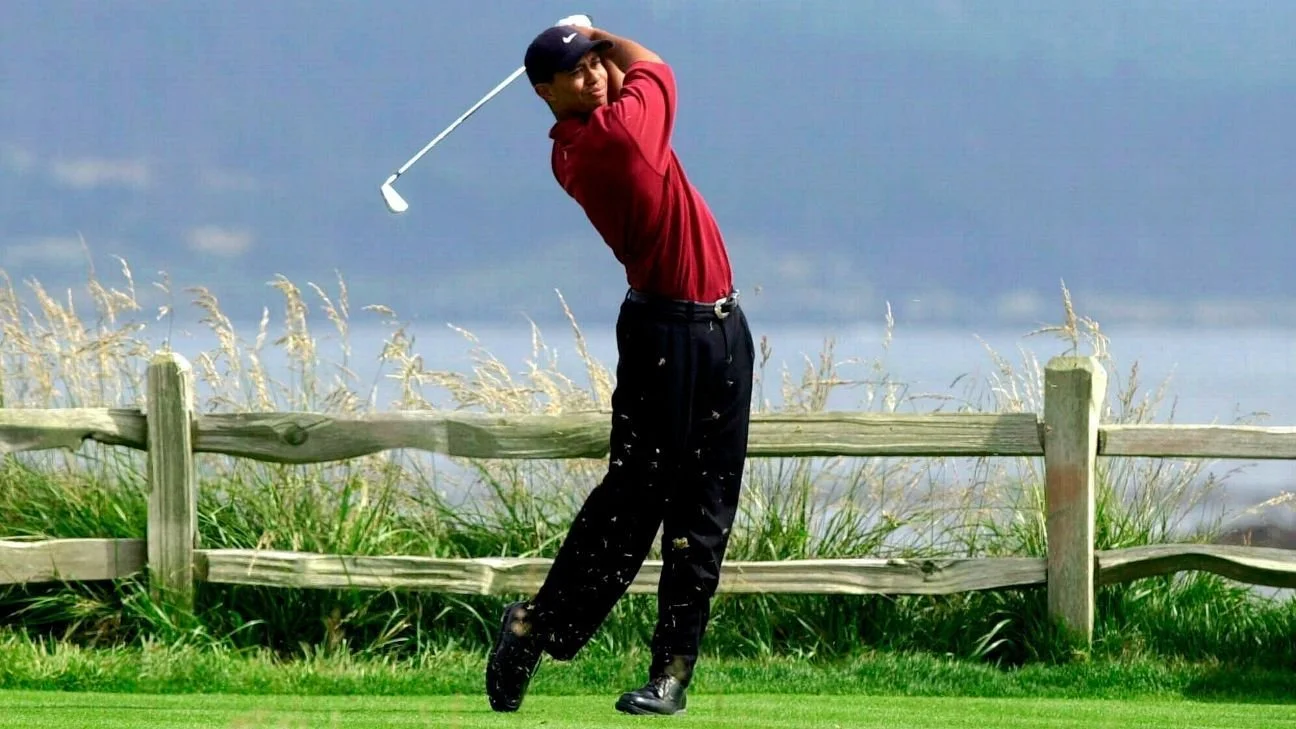
Tiger Woods at the 2000 U.S. Open at Pebble Beach
First published August 4, 2026
In 2000, Eldrick Tont (Tiger) Woods* achieved the greatest annual performance of any golfer before or since. This accomplishment began with the U.S. Open in Pebble Beach, at which he finished at 12 under par and won by 15 strokes. Those tied for second place were three strokes over par. This score remains the largest margin of victory ever achieved in a major championship. [Tiger also holds the record for the stroke margin of a win in the Masters: 12 strokes. He is the youngest golfer to win the Masters at age 21 years.] In 2000, he then won the Open Championship (British) at St. Andrews by eight strokes. At the Professional Golf Association (PGA) Championship, in Valhalla, he won in an exciting playoff. In the spring of 2001, he completed the “Tiger Slam”, winning the Master’s Tournament. Thus, at age 24, he held all four major championships simultaneously, the only golfer to ever do so. Only he and Ben Hogan in 1953 have ever won three majors in one year.
In this banner year, 2000, Tiger won nine of the 20 PGA events he entered. He finished second in four tournaments. Thus, he finished in first or second place in 65% of PGA events he played that year. He was among the top five finishers in 17 of 20 PGA events. He found the green in regulation in 75% of holes played in 2000 and averaged five birdies per round in the 20 events, which led scoring on the tour. Tiger dominated virtually every round. To no surprise, Tiger led the Tour in 2000 with a scoring average of 67.79, the lowest Tour score in history. No other golfer has come within a full shot of this scoring average since 2000, except for one man, Tiger Woods himself, six times. His performance in 2000 resulted in his being named the PGA Player of the Year and Associated Press Male Athlete of the Year.
In 2000, Tiger also won golf’s Triple Crown, the three National Open Championships: the U.S. Open, The Open (British) and the Canadian Open. At the Canadian Open at Royal Glen Abbey, in Oakville, Ontario, he won by shooting 22 under par. In the final round, he made two notable shots, one considered by two pros interviewed after the tourney as the greatest golf shot they had ever seen. The iconic 6-iron shot was on the par five 18th hole in the final round. Tiger was up by one stroke. Tiger’s tee shot settled in a large bunker off the right side of the fairway. The pin was on a sloping green, 213 yards away across a large body of water. Trees prevented a view of the pin. Tiger shaped the shot so the ball settled just off the upper edge of the green and, subsequently, he made a chip to near the hole and sank the putt, his fourth shot for a birdie. This save resulted in his winning the Canadian Open Championship by one stroke. The iconic shot can be viewed on YouTube (“Tiger Woods’ historic 2000 Canadian Open win”). Tiger Woods’ performance in 2000 remains the singular annual achievement by a professional golf player, 26 years later.
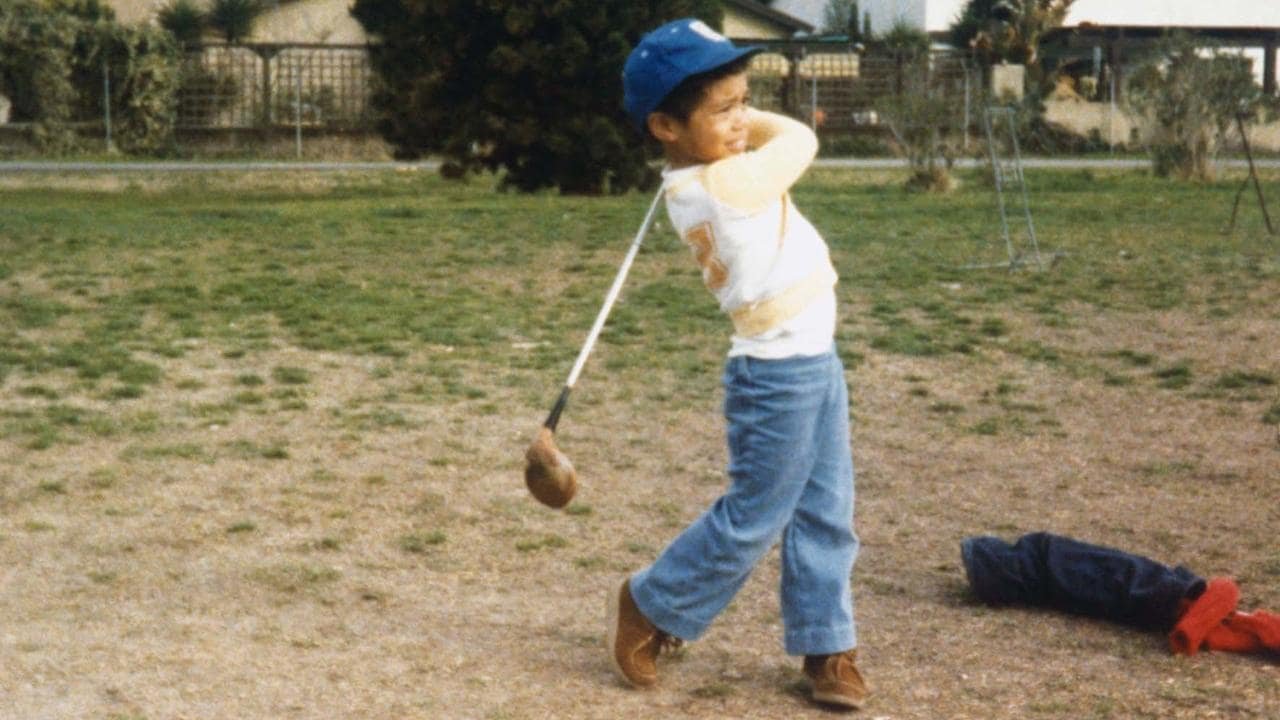
Tiger’s skill, confidence, and focus on a golf course were evident by age three when he ostensibly had a score of 48 on nine holes at the Navy Golf Course in Cypress, California, hitting from the red tees and with other special assists. Golf Digest reported this feat, which had several witnesses. Three years old! Yikes. At age six, he won a drive, pitch, and putt tournament in the 10-year-and-under category.
Tiger’s subsequent injuries, requiring multiple surgeries and with residual chronic back and limb pain, has shortened his career and led to dependence on narcotic analgesics, which impairs his awareness and has resulted in car crashes and arrests for driving under the influence. Alcohol has not been involved. The use of these drugs has tarnished his image as he aged out of active participation in competitive golf. Some consider him the greatest golfer in history. Analytics, especially as applied to the four major tournaments, indicate it is Jack Nicklaus. On the other hand, Tiger held the number one position in professional golf for 683 weeks during his career, the longest stretch of any golfer. He also won more PGA events than Nicklaus. Although Woods is tied with Sam Snead for the most PGA wins, 82, Tiger’s era of play required at least completion of a 54 hole tournament to be recorded a PGA win, whereas Snead’s PGA victories include those with only 18 or 36 holes played. If the 18-hole minimum that was applied to Snead’s victories was also applied to Tiger’s record, he would have 95 PGA Tour titles.
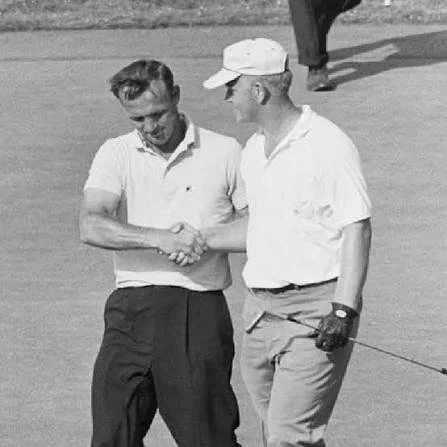
Jack Nicklaus and Sam Snead at Pebble Beach, 1963
Comparing golfers from different eras is complicated and several factors may change over time that influence outcome. There have been a number of extraordinary professional golfers through the years. Few would argue, however, that Woods’ and Nicklaus’s records have set them apart.
Tiger’s career was shorter than either Nicklaus’s or Snead’s because of injuries. His achievements as one of the two greatest golfers in history have made him both enormously wealthy and an éminence grise in the sport. One hopes he can find a path forward without drug dependence.
Given the popularity of golf worldwide, one should anticipate other prodigies appearing in the future. Three-year-olds with a premature coordinated swing and with putting skill that may lead them to a Tiger-like career.
*The name Eldrick was fashioned to start with an “E” for his father, Earl, and end with a “K” for his mother, Kutilda. “Tont” is a Thai name recognizing his mother’s birthplace in Kanchanaburi, Thailand. His nickname “Tiger” was given to him as an infant by his father in recognition of a South Vietnamese officer who fought with Earl Woods in Vietnam. His name was Vuong Dang Phong, but he was called “Tiger”. Earl Woods hoped that his son would develop the courage displayed by his Vietnamese comrade.