The Spanish Civil War and the origins of M&M’s Chocolate Candy
First published August 2, 2026
A partnership between Forrest Mars, Sr., CEO of the Mars Candy Company, and Bruce Murrie, the son of the President of the rival Hershey Chocolate Company, resulted in the M&M candy, named by using the first letter of Mars and Murrie.
M&M’s were first patented and produced in the United States in 1941. However, the idea for M&M’s came from Smarties, a chocolate candy made by the British Company, Rowntree’s, carried by combatants during the Spanish Civil War (1936-39). This candy had a hardened sugar syrup coating, allowing the chocolate candy to be carried in a hot climate without it melting. Forrest Mars, Sr., traveling in Europe in the 1930s, observed British and International volunteers in Spain eating these small candy-coated chocolate pellets. At the time, before air conditioning, sales of chocolate candy plummeted in the summertime. He seized on the idea. He gave William F. R. Murrie, President of the Hershey Chocolate Company, a 20 percent share in the product, allowing the candies to be made with Hershey chocolate, which had control of the rationed chocolate supply in the 1940’s. During World War II, the requirements for cocoa, sugar, and milk for calorie-dense foods for troops resulted in rationing and a severe scarcity of chocolate in civilian markets. In the early 1940s, the Mars company's first big customer was the U.S. Army. The ability of soldiers to carry chocolate in tropical climates without it melting was very useful. During World War II, the candies were only sold to the military.
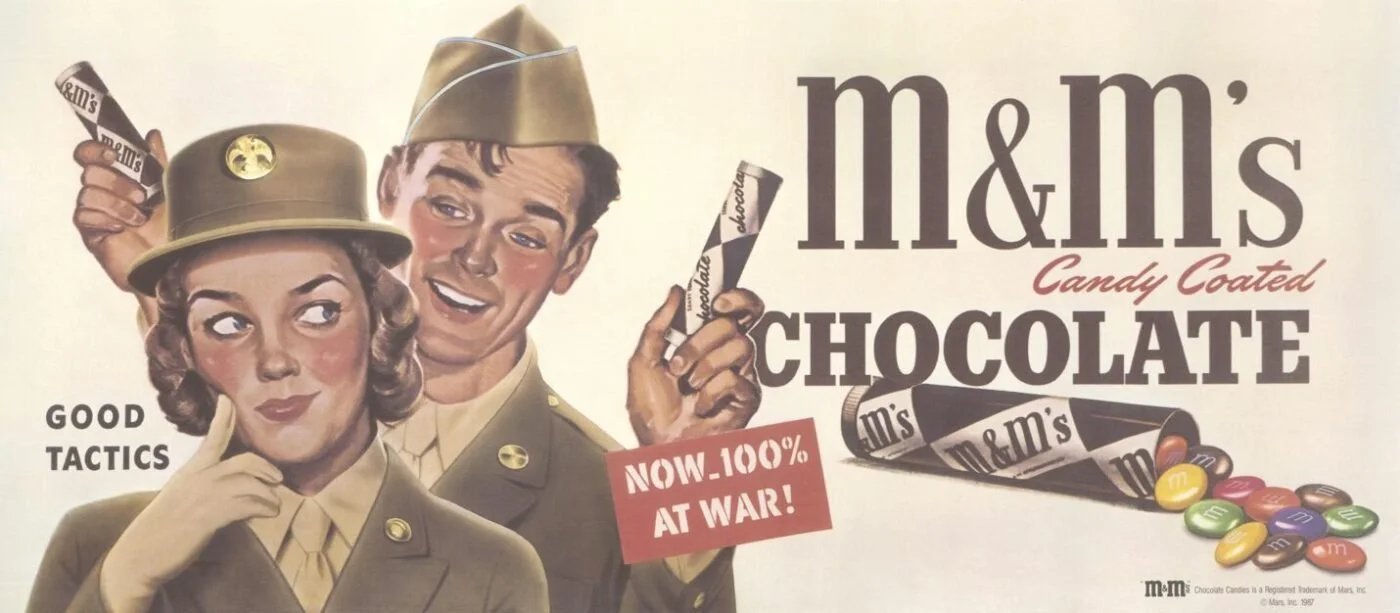
After World War II, M&M’s became a featured candy of the Mars Company, having many innovations, including colors. In 1949, the brand introduced the tagline "the milk chocolate that melts in your mouth, not in your hand". In 1950, a black "M" was added to the candy’s surface, giving it a unique trademark. The “M” was changed to white in 1954. In the early 1950s, Mars developed a process that allowed 3,300 pounds of chocolate centers to be coated in an hour, enhancing productivity. In 1954, the company introduced a peanut variety, which was only colored tan. In 1960, they added green, red, and yellow colors. They innovated by producing several other varieties (e.g., pretzel, almond, caramel, dark chocolate).
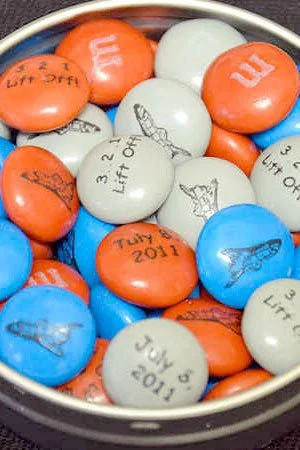
The properties that made them durable in tropical climates made them appropriate for space travel. The crew of NASA’s first space shuttle, Columbia, requested M&M’s for their flight in 1981. Thus, they became the first candy provided for astronauts. Since MM is the Roman numeral for 2000, Mars dubbed the M&M “The Official Candy of the New Millennium”. In 2011, to mark NASA’s final space shuttle launch, the Mars Company made special versions of M&M’s with an image of the shuttle, Atlantis, the date of the launch, July 8, 2011, or the statement “3,2,1…Lift Off!” on the candy.
The marketing approaches for M&M’s have been numerous, being related to movie openings, sporting events, and international sites among other sales campaigns. The use of “spokescandies” and personalizing messages on M&M candy for birthdays, weddings, or anniversaries are among their marketing techniques. M&M’s are one of the most popular and best-selling candies in the world, available in about 100 countries. They are near the top of U.S. chocolate candy sales annually, in close competition with Reese’s Peanut Butter Cups. On the dark side, over its lifetime, the Mars company was involved in several scandals, including abusive child labor in Africa using very young children to pick cocoa beans.
Mars, Incorporated is a family-owned company with a large list of products in confectionery, pet care, and food. The Mars family is considered the third richest family in the US after the Walton family and Koch family.