Allan Houser: An Extraordinary Native American Sculptor
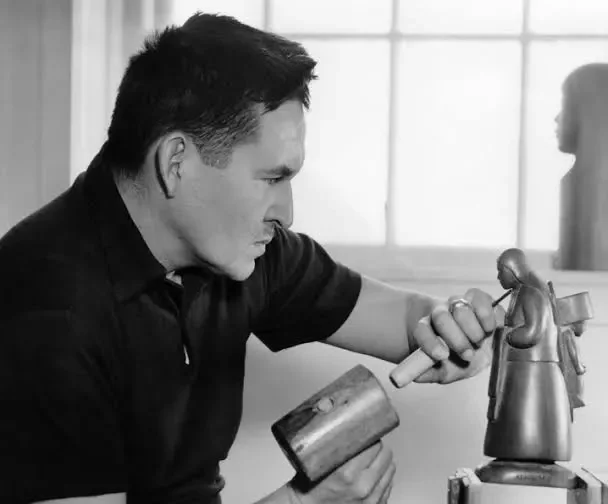
First published August 31, 2026
Allan Capron Haozous (1914-1994) was a Chiricahua Apache born on his family farm in Apache, Oklahoma, and the first in his family to be born outside of captivity. His father, Sam Haozous, and mother, Blossom Haozous, chose to start a farm in Oklahoma rather than accept resettlement with the Mescalero Apache tribe in New Mexico, a choice given to them when they were released from captivity in Fort Sill in 1913. The United States government had imprisoned the Warm Springs Chiricahua Apache tribe immediately after the surrender of the Apache chief Geronimo in 1886.
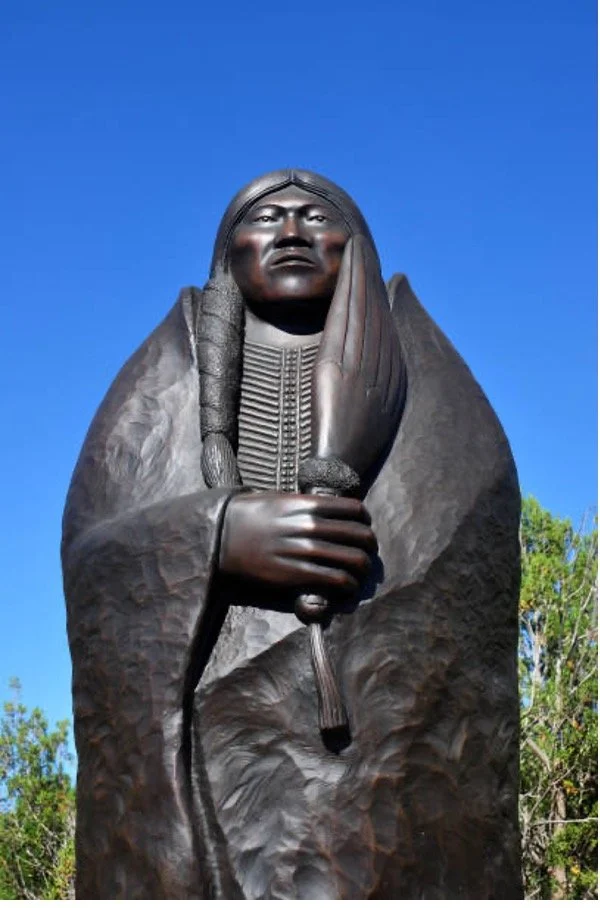
Statesman of the Plains sculpture
Allan was a grandnephew of Geronimo, and his father had served as a translator for Geronimo and provided an oral history of the Warm Springs Apache’s road to survival. As Allan’s artistic career progressed, he changed his last name to one more readily appreciated by non-Native Americans and was known during most of his career as Allan Houser. Houser is credited with revolutionizing Native American fine art, notably sculpture, by blending traditional tribal art with contemporary, fluid, and abstract forms. His works led him to become the Dean of Native American sculptors. He is one of the leading artists of the twentieth century, blending Apache shapes with modern artistic lines.
Houser trained at the Santa Fe Indian School under the guidance of Dorothy Dunn. Initially, he became an accomplished painter. His early work showed his talent and inventiveness. This led to his invitation to paint murals for the U.S, Department of the Interior. In the early 1940’s Houser took his first steps into sculpture by carving some small wooden figures. This approach captured his interest, and he moved, largely, from painting to sculpture, which became his principal artistic endeavor. By the 1950s, he had become a teacher at the Inter-Mountain School, where he was also an artist-in-residence. Thereafter, his works of sculpture attracted international attention. Museums purchased his works for their collections. He was recognized as an exceptional sculptor, and his style of forming shapes attracted worldwide recognition.
In the early 1960’s Houser moved to the Institute of Indian Art in Santa Fe, where he was a dedicated and nurturing instructor. He taught for over two decades, after which he focused solely on his art. For another two decades, he produced numerous works, exhibited at many museums, and responded to special commissions. He had international exhibitions in France, Germany, Austria, and Japan and, of course, many in the U.S. He received numerous awards for his work. In 1991, he was the recipient of the National Cowboy and Western Heritage Museum's Prix de West award for his bronze sculpture, “Smoke Signal.” Houser was the first Native American artist to earn a National Medal of the Arts in 1992 from President George H.W. Bush.
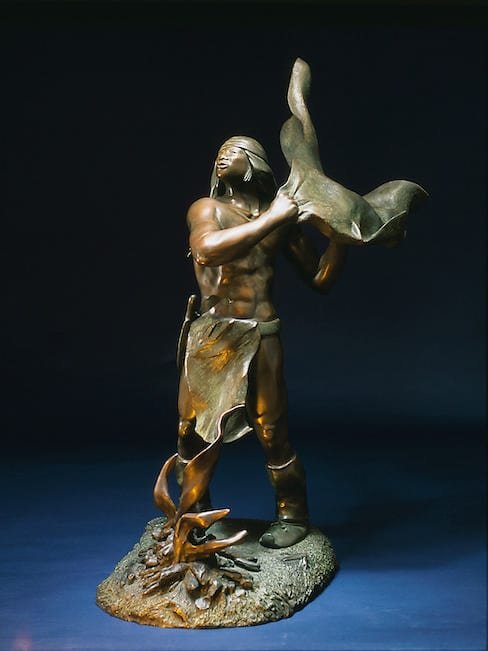
Smoke Signal Sculpture
The Allan Houser Gallery in Santa Fe, near the Santa Fe Plaza, exhibits his work. In 2014, the gallery celebrated the 100th anniversary of his birth. In the summer, one can take a tour of the Houser Sculpture Garden at the family property off the Turquoise Trail National Scenic Byway. This scenic and historic area occupies 15,000 square miles in central New Mexico, linking Albuquerque and Santa Fe. The drive is approximately 50 miles along Highway 14. It provides an exceptional view from the top of Sandia Crest and passes through the mining towns of Golden, Madrid, and Cerrillos, each restored to life with a vibrant array of art, crafts, theater, music, museums, and restaurants.