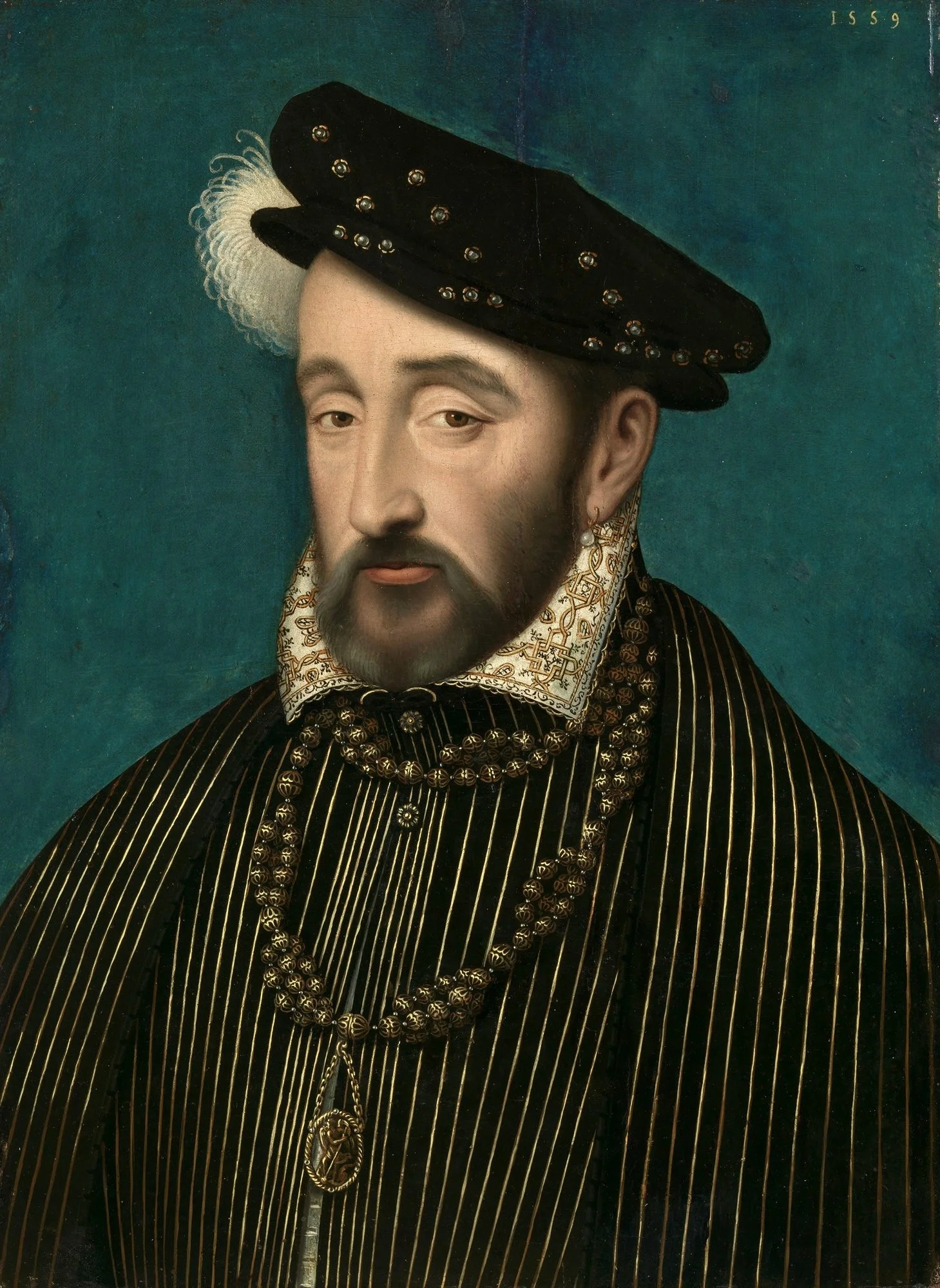
King Henry The II Of France
First published July 24, 2026
Early in the 16th Century, Henry II (1519-1559) was King of France and the head of the House of Valois, one of the two royal dynasties that dominated Europe at that time. Opposing the House of Valois were the Habsburgs led by the Holy Roman Emperor Charles V and his son, King Phillip II of Spain.
This period was a significant time in European and world history as the Renaissance and the Protestant Reformation were underway, and it was the age of exploration. Henry had responded to the rise of the French Protestants (Huguenots), led by theologian John Calvin, with brutal repression. Henry was a rigid Catholic. He issued Edicts that encouraged the persecution of the Huguenots. He also set up a tribunal that could issue social and physical punishment to the Huguenots using ghastly forms of punishment such as burning at the stake.
At that time, the marriage of royals from competing families was a means to cement political relationships and to remove enmity between adversarial powers. On June 30, 1559, in Paris, the House of Valois and the Habsburgs were celebrating the marriage of Henry II’s 14-year-old daughter to the widowed Phillip II of Spain. Simultaneously, Henry’s 36-year-old sister was to marry Emmanuel Philibert, the Duke of Savoy. These weddings would create a bond between Europe’s two major dynasties, an event of great consequence in European history. Henry served as the host for the weddings in Paris, along with his wife and consort, Catherine de’ Medici (1519-1589), mother of the 14-year-old bride. Another participant at the weddings, Diane de Poitiers (1499-1566), had mentored Henry during his youth and became his mistress and close confidant. Diane was Henry’s singular love. She was an older cousin of Catherine’s and twenty years older than Henry, although still beautiful in her 60’s.
As a part of the celebration, King Henry insisted that he participate in a joust. In this case, usually, two knights used blunted weapons to distinguish the jousts à plaisance (jousts of peace) from the jousts à la guerre (jousts of war). Henry, known for his horsemanship and jousting, decided, given the grandeur of the occasion, to participate despite efforts to dissuade him to forego this action. During the joust, the two opponents charged at each other with a 5-foot-high barrier to the left of the opposing combatants. The lance was carried in the right hand and was pointed over the left ear of their bejeweled horse. (Fig. 1) The combatants had a saddle with a high front to protect their groin and were fitted with armor from head to toe, including a helmet with eye slits.
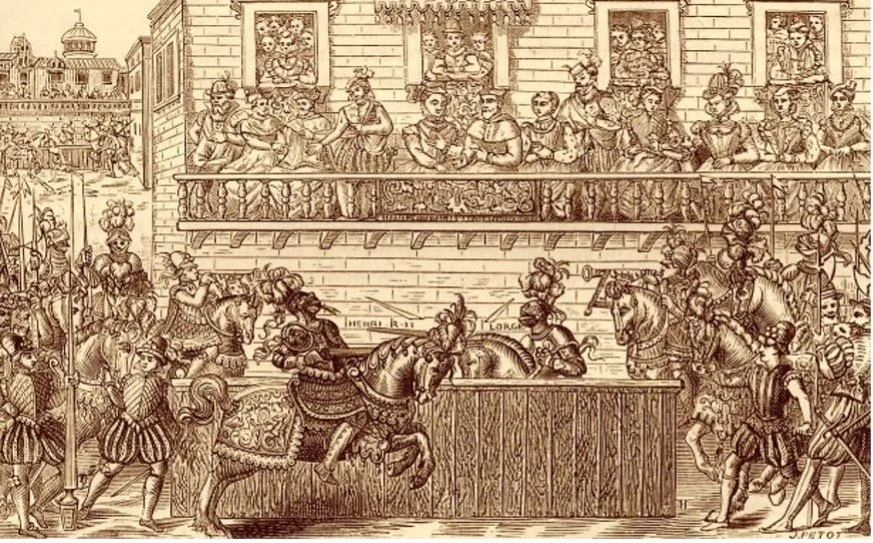
Fig. 1. Woodcut of the joust with the lance’s tip penetrating the eye hole of Henry’s helmet
On the fateful day, the royal box was full of prominent persons from both royal houses, the Valois and the Habsburgs. As the King and his knightly opponent made contact, both lances broke, but the King’s opponent’s broken lance tip entered the King’s visor eye hole and then the King’s brain near the right eye. It would be a fatal wound.
The two most notable contributors to Renaissance medicine, Andreas Vesalius, “the father of modern anatomy,” and the most influential human medical anatomical scientist to that point in history, and Ambroise Paré, “the great surgical innovator”, were summoned to try to save the King. Despite the efforts of his physicians, the King had suffered a severe penetrating wound of the right eye and brain and died of an infection 11 days after the joust. (Fig. 2) Vesalius performed the autopsy.
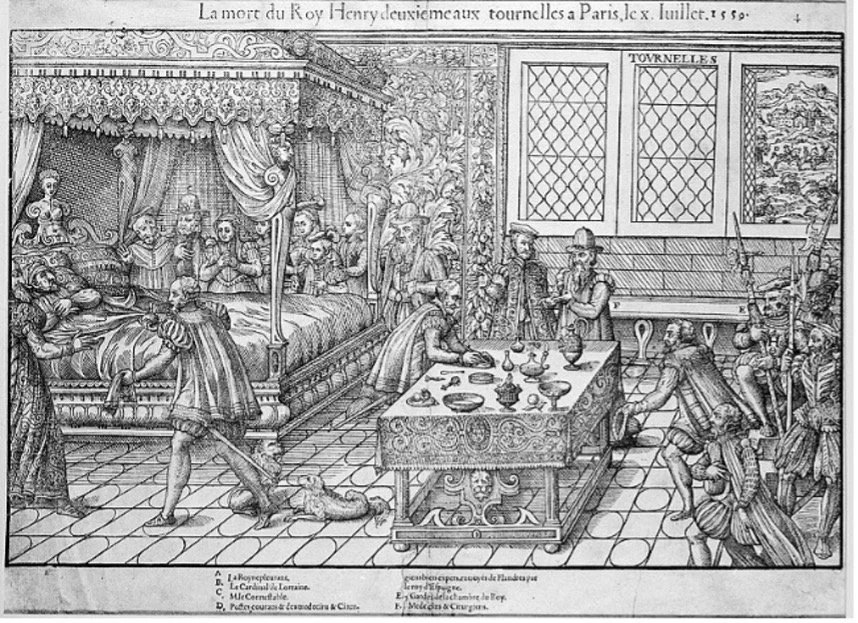
Fig. 2. Woodcut of the deathbed of Henry II with his physicians in attendance
Henry’s successors were his children, which elevated their mother Catherine de’ Medici’s influence and power to that of a monarch. His son, Francis II, age 15 years, who married 16-year-old Mary, Queen of Scots, succeeded Henry II, initially. Francis died 18 months later in 1560, and Mary returned to Scotland. His 10-year-old brother Charles IX succeeded Francis. Catherine de’ Medici acted as Regent for her young son. During the 30 years between Henry II’s and her death, she determined the policy of France.
Shortly after Henry II’s death, starting in 1562 and for the rest of the century, French Protestants and Catholics fought the multiple Wars of Religion that split the country. Notable the War of the Three Henrys, fought between the two Roman Catholic Kings, Henry III of Valois and Henry I of Lorraine, the 3rd duke of Guise, and the Huguenot leader Henry of Bourbon, King of Navarre.
Henry II’s death, resulting from the penetrating injury to his brain and the subsequent infection as a result of the joust, had a profound impact on the history of Western Europe. France’s power declined profoundly during the sequential reign of his three ineffective children, despite Catherine’s herculean efforts to reach a peaceful accommodation between Catholics and Protestants and preserve the Monarchy. In the end, she preserved the Kingdom sufficiently long to allow the succession of Henry IV, a Bourbon, through whom royal authority was restored. The years following Henry II’s death from his fateful joust à plaisance were so impactful in the course of European events that it has been designated the most consequential sports injury in history.