World War II. The Great Deception: Bodyguard
First published December 12, 2025
Operation Fortitude
Stalin was upset when the Allies invaded Sicily and then Italy in 1943. He wanted them to enter Western Europe closer to Germany to provide a proximate second front to take pressure off Russian troops in the east. The Allies, however, were not ready for an invasion along the French coast in 1943. The Italian campaign provided them a foothold in Europe, eventual elimination of Italian forces, one arm of the Axis powers, and a position closer to the Romanian oil fields in Ploiesti from which they could undertake saturation bombing to deprive the German war machine of a critical supply of oil to power its trucks, tanks, and planes. Initially, this operation, designated Tidal Wave, launched from bases in Libya. This action required a one thousand-mile flight, each way, pushing B-24 bombers to their limit. Fighter escorts were impossible over that distance, and the American bomber losses were heavy. From the Italian bases, much closer to Ploesti, a change to high-altitude precision bombing and the accompanying fighter aircraft protection was very successful. It reduced the production of the Ploesti oil complex by an estimated 80 percent, a significant blow to the German war machine.
At the Tehran Conference in November 1943, Roosevelt and Churchill shared plans with Stalin for an invasion of mainland Europe planned for 1944. Critical to this endeavor was a campaign of deception code-named “Bodyguard,” an effort to deceive Hitler and the German high command of the timing and location of the Allied invasion. Churchill commented to Stalin, “In wartime, truth is so precious that she should always be attended by a bodyguard of lies."
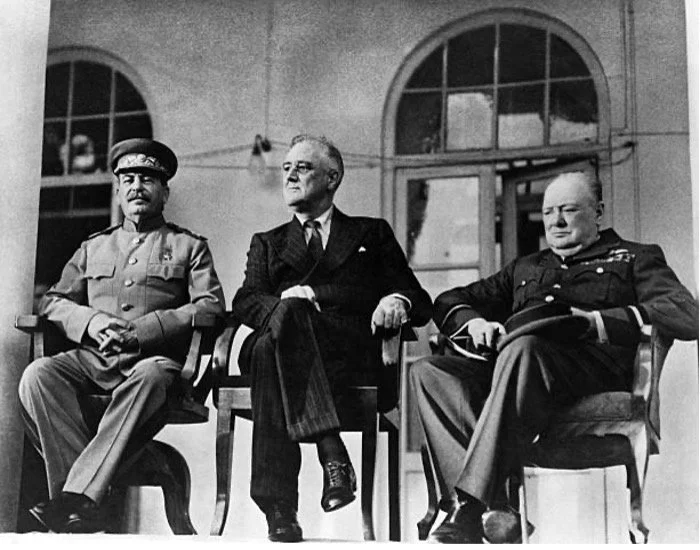
Stalin, Roosevelt, and Churchill at the Soviet Embassy in Tehran in November 1943. Stalin learns of the plan for the invasion of France in 1944.
Critical to Operation Overlord, the invasion of continental Europe at Normandy, were carefully orchestrated deceptions, intended to create credible threats from several vantage points, preventing the Germans from reacting to Allied actions in a decisive and effective manner. The goal was to develop probable threats of invasion from Norway to the Cote d’Azure. Hitler could not reinforce at any one point without accepting a high risk in other areas.
Having access to the German Enigma code machine allowed the Allies to be certain how the Germans were reacting to Operation Fortitude. Did they believe in its credibility? The British navy secured the German Enigma code machine, along with its codebooks, from a captured German submarine in May 1941. A combination of Polish and British mathematicians cracked its code. The Poles made the initial breakthrough, followed by the British cryptanalyst Alan Turing and colleagues at Bletchley Park. The German codes permitted the Allies to confirm their belief in the deception. The Allies used astute methods to keep the Germans from learning they had their code for the entire war years. In fact, the story of Enigma and its deciphering was not made public until nearly 30 years after World War II.
Of the several simultaneous deceptions about the site of an Allied invasion of Western Europe, two of the most effective were Fortitude North and Fortitude South.
Operation Fortitude North
Fortitude-North was designed to convince the Nazis that the invasion would be of Norway, after which they would advance south through Denmark to Germany.
A classic essay had explained the defeat of Germany in World War I as the result of Britain’s control of the North Sea, bottling up the German fleet. Hitler read this essay and was obsessed with controlling Scandinavia. Thus, soon after World War II began, he invaded Denmark and, then, Norway. Fortitude-North was a subterfuge to convince the Germans that the Allied offensive in the west would be first to free Norway and to drive through Denmark to Germany.
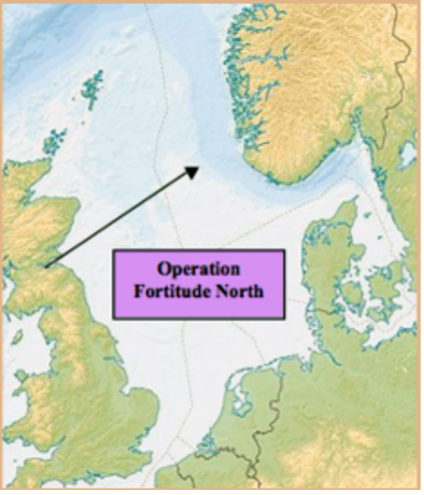
The invasion path from Scotland to Norway as part of the ruse of Fortitude North.
The Allies used Scotland, where German surveillance would be difficult, to create a faux army preparing for the invasion of Norway. The British chose General Sir Andrew Thome, well known to the Germans, to command the invasion force. He and his adjuvants created the British 4th Army, headquartered in Edinburgh Castle. The 4th Army consisted of fictitious British Corps and an actual U.S. Corps stationed in Northern Ireland. The latter’s three divisions were training to be a follow-up force at Normandy. Other fictitious components included American and British forces in other locales and a brigade of Norwegian expatriates in England.
A phantom army of over 250,000 troops with their own tactical air force and hundreds of armored vehicles, largely fictitious, was established. All this activity was made transparent to the Germans. The Royal Navy simulated assault ships practicing the loading and unloading of troops and gear. A network of communications among fictitious units and headquarters simulated a complex assembled force, training for an invasion of Norway. The use by British intelligence of two German agents, code-named Mutt and Jeff, captured in Scotland in 1941 and “turned,” provided their German Abwehr controllers with false intelligence to support this deception.
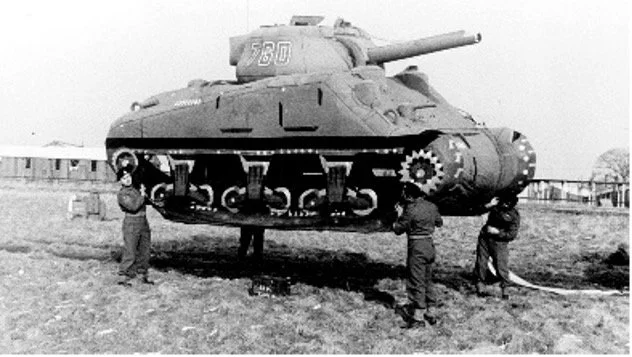
The models used to simulate tanks and deceive German reconnaissance flights.
The British created an actual diplomatic crisis with Sweden. The British tried to convince the Swedish government to let the allied invasion force use Swedish airbases and other assets. They withdrew the British ambassador to Sweden in (fictitious) pique after the Swedes refused, which disputes the Germans followed and added to the credibility of the invasion being in Norway. The Allies even tampered with the Swedish stock market to drive up the price of Norwegian securities to indicate investor speculation about an imminent invasion.
The deception of Fortitude North was a complete success, tying up many German divisions for the defense of Norway. Hitler not only would not move any of those assets, he reinforced them. Just before the Normandy invasion, the Germans had 13 Army divisions, 90,000 naval personnel, 60,000 air force personnel, and 18,000 SS and paramilitary forces in Norway and similar assets in Denmark. Keeping these forces out of France saved innumerable allied lives and added to the likelihood of success of the Normandy invasion.
Operation Fortitude South
Fortitude-South was the effort to convince the German intelligence service that the invasion of France would occur across the Strait of Dover. At that site, the distance from South Foreland in Kent, England to the Cap Gris Nez in the French Department, Pas-de-Calais, is 20 miles, the shortest crossing to Continental Europe. Hitler was convinced that a crossing at the shortest point was likeliest. It was logistically much easier and had land-based air support a short distance away. The deception was successful and decisive. The German 15th Army, including armored divisions, remained in Pas-de-Calais for weeks, even after the Normandy landings, waiting for the "second" main invasion that never came.
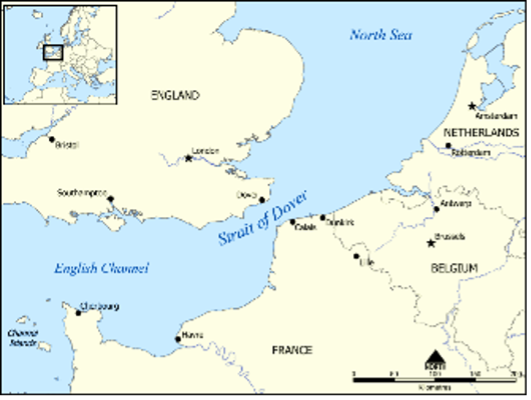
The proximity of Kent to Pas-de-Calais. The logical place for an invasion of Western Europe
Fortitude South created the appearance of eleven divisions, four corps headquarters, and supporting air, naval, and logistics in Southeast England, easier for German surveillance. Scripted wireless traffic and double agents would each play a part, as in the north, but the scope and location required subterfuge that was more extensive.
Large tent cities with continually smoking cooks’ stoves were created. Roads leading into woods simulated ammunition dumps and other supporting facilities. Inflatable tanks, trucks, and artillery, and faux military aircraft looked very real to high altitude German reconnaissance flights. Planes were made of canvas. Faux fleets of landing craft made of wood and canvas and supported by oil drums were anchored in several harbors. Aircraft engine sounds were broadcast over loudspeakers. Vehicle headlights on carts driven down runways at night simulated takeoffs for the benefit of the Luftwaffe. Fake storage and oil refining facilities looked so real that German aircraft bombed them. Numerous areas of deception representing airfields, ports and assembly areas drew German bombers away from actual staging sites, after which flares and fires would be lit, giving the false impression of successful German strikes.
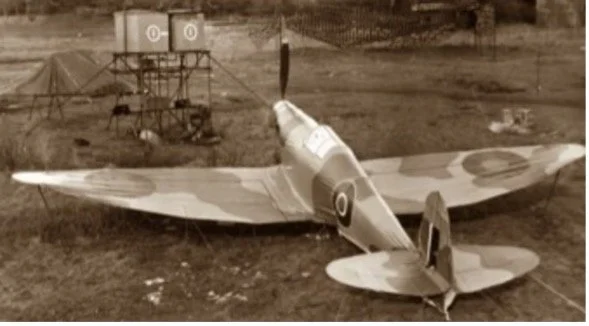
The faux Spitfire. Good enough to fool high-flying German reconnaissance planes.
A significant step was to name Major General George C. Patton as the commander of this faux invasion force. The Germans thought him the Allies best general after his successful campaigns in North Africa and Sicily, and they were convinced he would lead any invasion. The force was designated the U.S. 3rd Army and was composed of multiple armored and infantry divisions and the Canadian First Army. Whatever was expected of this large array of troops was simulated, including supply and other logistical problems and misbehaving troops.
A unique device, code-named “moonshine”, could amplify German radar pulses and return what appeared to be larger ships or formations. The Allies heavily bombed rail lines and road networks in the Pas-de-Calais, as if preparing for an invasion at that site. On the day of the Normandy invasion, June 6th, simulated invasion forces appeared on German radar heading for the Pas-de-Calais. Chaff was used to simulate bomber formations to attract German fighter planes away from the actual invasion site at Normandy in order to reduce the risk to gliders carrying troops.
Hitler and German intelligence were convinced the attack would be at Pas-de-Calais. Even for weeks after the Normandy invasion, they thought it a diversion and the main invasion forces would arrive at the Pas-de-Calais. Elaborate misdirection by captured German agents working for the Allies fed the Germans’ misinformation, coupled with accurate information of little value. The British repatriated a captured German general who was very ill to Germany after he was made privy to conversations carefully crafted about the invasion at Pas-de-Calais. On his return to Germany, he shared this information directly with Hitler. Even into July 1944, two months after the Normandy invasion, Hitler did not think it was the main attack, which was yet to come at Pas-de-Calais. Maintaining massive forces in Sweden, Denmark, and the Pas-de-Calais region allowed the beachhead in Normandy and the breakout into the French countryside to be successful.
Later, General Omar Bradley wrote to General Eisenhower that Hitler was paralyzed into indecision by his fear of the strike at Pas-de-Calais, withholding a minimum of 20 divisions and supporting airpower for the defense of Pas-de-Calais, not committing them to Normandy. He emphasized the critical role Operation Fortitude played in the ultimate success of the Allied landing at Normandy. There were fraught moments, and a substantially larger German ground and air force could have been disastrous for the Allies.
Double Agents in the Success of Operation Fortitude
A key element of the successful misdirection that convinced Hitler and most of his top generals to withhold assets from Normandy was the use of double agents turned by British intelligence uncovered early in the war, circa 1941. These agents continued to feign working for the Germans, giving them credible access to German intelligence agencies. Hitler was very aware of this conduit of information about Allied plans. The British Double Cross Committee (XX Committee) controlled the double agents. Their work was crucial to Operation Fortitude and the deception campaign that convinced the Germans the main invasion might occur in Norway or the Pas-de-Calais, not Normandy. Double agents had convinced the Germans that Normandy was a diversion from the main invasion force set to cross at the Pas-de-Calais.
Although there were at least eight very important double agents working for the British XX Committee, Juan Pujol Garcia was the most famous and effective. He was referred to as “Agent Garbo” because of his successful dual roles as a faux German and actual Allied spy. In the late 1930s and early 40s, Greta Garbo, a Swede, was in her prime as an illustrious Hollywood actor.
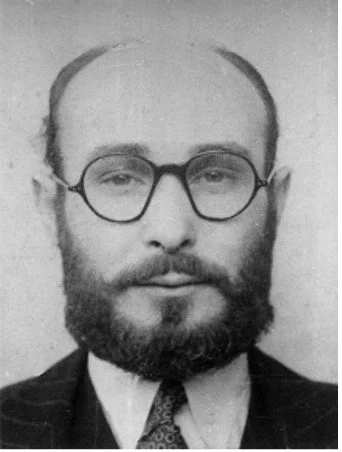
Juan Pujol, aka Agent Garbo. The Allies’ most valuable double agent in Europe.
Pujol was an antifascist who was determined to make a contribution for the “good of humanity” during World War II. He was rebuffed when he offered the British his services. He, then, schemed to ingratiate himself with the Germans to mislead them. While operating out of Portugal, he created a fictitious network of 27 sub-agents, as well as himself, working in Britain, each with full life stories. He used them as (imaginary) sources and sent numerous messages to his handlers in the Abwehr, German Intelligence, about British and, later, Allied plans. Truthful intelligence that would create little damage to the Allies was included to add to his credibility.
German intelligence used a postal box in Lisbon to exchange information. In 1942, Pujol again contacted British intelligence. On this occasion, he was brought to London, where he was recruited as a double agent. To enhance his credibility with the Germans, he sent them a letter advising of the date of the Allied invasion of North Africa. British intelligence predated it. However, it was delivered the day of the invasion, too late to make it useful. Nevertheless, the accuracy of the information impressed his German handlers.
Just after Normandy, Germany began using its V-1 rockets to bomb London. To maintain his cover, Pujol had to respond to their request that he give them real coordinates, so they could hit actual targets. Throughout, they thought he and his fictitious agents were in Britain. While there were casualties and damage, his truthful information was designed to minimize them.
He sent the Germans minor information about the invasion at Normandy in order to maintain his credibility. He and his “other” agents fed the Germans intelligence indicating this plan was a clever distraction; the main Allied attack was to come, as Hitler expected, through Pas-de-Calais. This misdirection fed Hitler’s preconceived ideas and played a key role in the success of the invasion of Normandy.
On 29 July 1944, German intelligence informed Pujol that Hitler had awarded him the Iron Cross for his help with V-1 rocket targeting. Four months later, on November 25 of that year, he also received a Member of the Order of the British Empire (MBE) from King George VI for his contribution to deceiving the Germans about the Normandy invasion. Pujol is the only person to have received major awards from both sides for his services in World War II, enshrining his effectiveness as a double agent.
Bodyguard, incorporating operations Fortitude North and South, were invaluable subterfuges in securing the Allied beachhead in Normandy, the prelude to the defeat of German forces in Europe.