Painting as a Pastime: The Views of Winston Churchill
First published December 8, 2025
Winston Churchill was among the most interesting, literate and impactful political leaders of the 20th Century. Some would say “the most”, for which there is evidence. Few others have played a major role in so many significant world events over so long a time. No other politician of that era could use the English language in speech and writing with such power, insight and poetry. His role reached its pinnacle as the singular political force resisting the Nazi regime, leading to the eventual defeat of “Herr Hitler” and Germany’s Third Reich. He, also, provided the early awareness of the dangers of the Communist Russian bear. On March 5, 1946, Winston Churchill and President Harry Truman used a college gymnasium in a small Midwestern town for the former British Prime Minister to deliver his most famous post-World War II address, "The Sinews of Peace (Iron Curtain speech)."
A small Missouri college president had the audacity to ask a Westminster College alumnus with access to the President of the United States to ask President Truman to invite Churchill to speak at his small and little known college: an unlikely site. Truman’s willingness to endorse the invitation, and the insightfulness of the recently defeated Prime Minister to recognize an opportunity, led to this historic lecture, which included his famous phrase. “From Stettin in the Baltic to Trieste in the Adriatic, an iron curtain has descended across the Continent.” Read this insightful speech by accessing it through a search engine. It is poetic and insightful and speaks to our politics today as well.
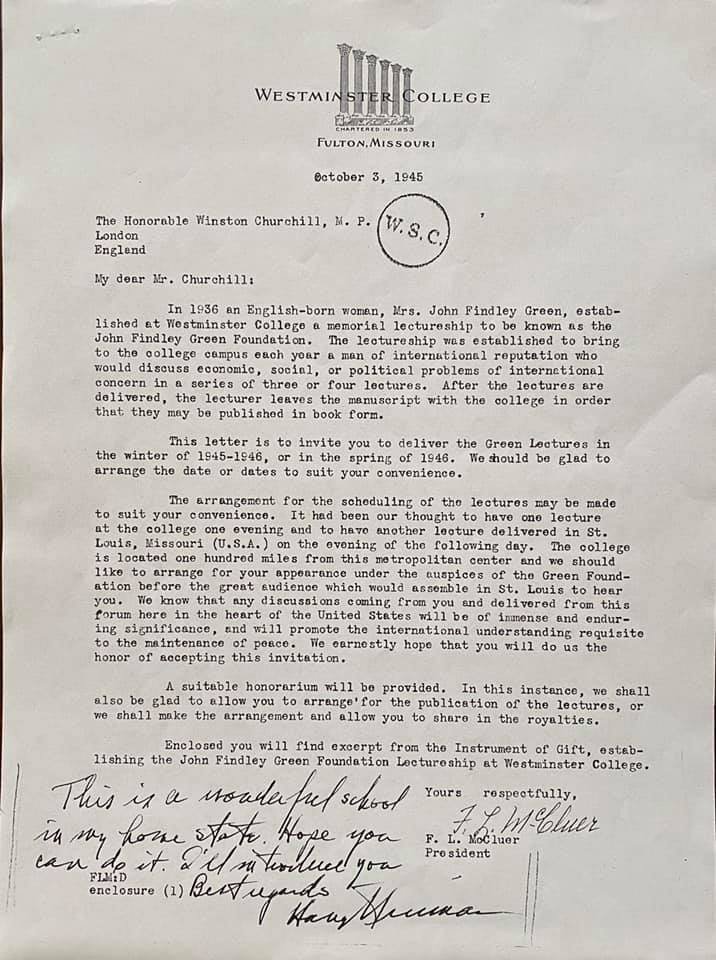
Letter sent by the president of Westminster College inviting Winston Churchill to speak there. He had President Harry S. Truman insert a handwritten note on the letter encouraging Churchill to accept and that he would introduce him.
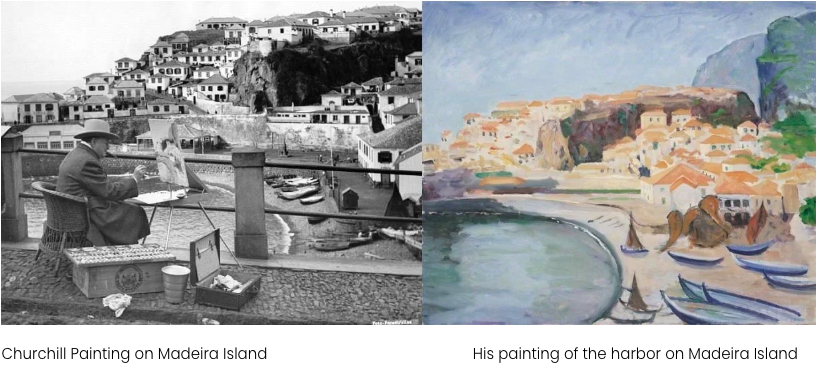
It is, however, to Churchill’s views on oil painting as a wonderful, indeed singular, diversion that I call to the reader’s attention. This interest is especially pertinent to the many at our residential community at Avocet Playa Vista who find painting a captivating pastime and participate in art classes. Churchill began to paint at age 40 after the failure of the Gallipoli campaign in World War I. It became a passion and a relief from the pressures of his life. He had severe depressive episodes and painting gave him solace. The paintings captured the places he visited for conferences or holidays and historical moments. For example, he gifted The Tower of the Koutoubia Mosque, painted after the Casablanca Conference in 1943, to President Franklin Roosevelt.
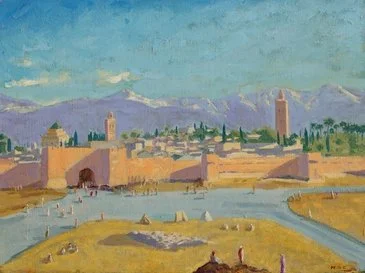
The Tower of the Koutoubia Mosque, gifted to Franklin Roosevelt
Churchill’s more than 500 paintings led to his election as an Honorary Academician Extraordinary by the Royal Academy in 1948, remarkable recognition for an amateur artist. He adopted an Impressionistic style, similar to Cezanne and Monet, in an effort to capture their view of light and color. Churchill gave many of his paintings as gifts to friends, colleagues, and other world leaders. Today, they command a high price at auction. His charming and disarming monograph Painting as a Pastime, encourages others to take up this hobby as a way to find joy and peace. Ninety-four examples of Churchill’s paintings can be found at the link: https://www.wikiart.org/en/winston-churchill

Churchill’s monograph on the joys of painting
As the 20th anniversary of Churchill’s speech in 1966 approached, Westminster College planned a celebration of the anniversary of Churchill’s visit to the campus and his historic speech. It, in effect, marked the beginning of the “Cold War”. After much discussion, a nominal celebration of that anniversary became a monumental plan. Westminster College decided to move a Christopher Wren-designed Church from London. The St. Mary’s the Virgin Aldermanbury Church was erected in 1677, replacing a prior structure built in the 12th century. The church building was severely damaged during the London Blitz. Westminster College arranged for it to be dismantled and moved stone by stone to its campus. There it was rebuilt to Wren's original specifications. The architectural feat to rebuild it using the 7000 meticulously numbered stones was notable. The church building forms a part of the Churchill Museum on campus. The museum uses advanced technology to capture the historic life of Winston Churchill and his world. The permanent exhibition and periodic temporary exhibits, together with programs and events, give it breadth and vigor characteristic of Churchill’s impact on his world.
The United States Congress cited the museum as America’s permanent tribute to the great political leader and formally designated it as the America’s National Churchill Museum in 2009.