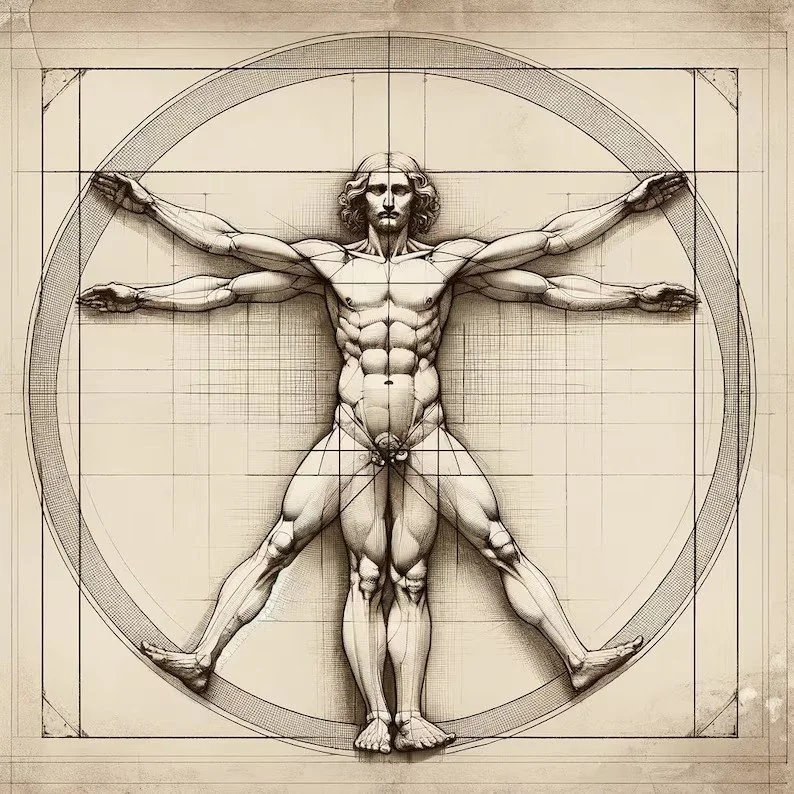
The Vitruvian Man, first created by da Vinci circa 1490, is a mathematical and geometrical study of the human body and its relationship to the worldly (square) and divine (circle).
First Published October 19, 2026
Leonardo da Vinci (1452-1519) had one of the most insightful, wide-ranging and brilliant minds in human history. The Renaissance polymath is considered one of the greatest painters to ever hold a brush. He gave us legendary masterpieces like The Last Supper and the Mona Lisa. He was a conceptual engineer designing complex and ingenious devices like flying machines and armored tanks centuries before they became realities. His meticulous dissections mapped human anatomy with unprecedented precision for the first time. Leonardo’s notebooks contained conceptualizations related to art, anatomy, astronomy, botany, cartography and paleontology, for example. Isaac Newton’s proposals regarding the laws of motion and Albert Einstein’s concepts of time and space, resulting in his theories of special and general relativity, transforming physics, were expressions of genius. However, the sheer breadth of Leonardo’s genius remains singular, considering he worked four centuries earlier, when far less was known.
A fascinating question has emerged, however, about his parentage: was Leonardo's mother Jewish?
According to Professor Carlo Vecce, a leading Leonardo scholar and historian at the University of Naples L’Orientale, the answer is “yes”. Vecce, who has published a biography entitled Leonardo and an anthology of Leonardo’s writings, detailed his findings in his 2023 book, Il sorriso di Caterina, la madre di Leonardo (The Smile of Caterina, the Mother of Leonardo). Ironically, Vecce set out to disprove the long-standing rumor that Leonardo's mother was not Italian. Instead, his scrupulous search of the archives resulted in an unexpected finding, which led Vecce to an unexpected conclusion.
The breakthrough came when Vecce discovered a legal document dated November 2, 1452, six months after Leonardo was born. Leonardo’s father, the notary-solicitor Piero da Vinci, signed the document. It was an act of emancipation liberating a woman named Caterina, the daughter of a man named Jacob from the Caucasus Mountains. Caterina had been an indentured slave serving the wife of a wealthy Florentine merchant, Donato di Filippo, who was one of Piero’s clients. Piero da Vinci drew up the legal paperwork to free the woman who had just given birth to his son, Leonardo.
By retracing the era's Jewish history, Professor Vecce mapped Caterina's forced journey. A Circassian Jew from the Caucasus, she was taken to Crimea, boarded onto a slave ship to Constantinople, and sent through Venice before arriving in Florence. There, di Filippo bought her, putting her to work in his clothing workshop and in his home to serve his wife. Catrina was also a sex slave, bearing several children with di Filippo. Her path crossed with Piero da Vinci through his legal work for the merchant. With di Filippo's permission, Piero occasionally borrowed Caterina to watch his daughter. These contacts eventually resulted in a loving relationship with her. After she gave birth to their son, Leonardo, Piero da Vinci freed her. Additionally, Piero's notary client list showed that he maintained close ties with Florence's Jewish community.
Despite his initial goal of proving Leonardo’s mother was Italian, Vecce’s extensive research into regional Jewish history and slave-trade routes convinced him that Caterina, Leonardo’s mother, was a Jewish woman from the Caucasus.
Not surprisingly, the academic world of Leonardo scholars is split; some experts remain skeptical of Vecce's conclusions; others are convinced by the documentation. Leonardo himself was raised a devout Catholic, and practiced the faith throughout his life, and expressed and honored it in his art. Yet, if Vecce’s discovery is true, it means Leonardo's genome was roughly 50 percent that of an Ashkenazi Jew. The debate is unlikely to reach a conclusive answer, but the proposal remains an intriguing possibility—especially when cited by a scholar of Vecce's caliber who originally set out to prove the opposite.
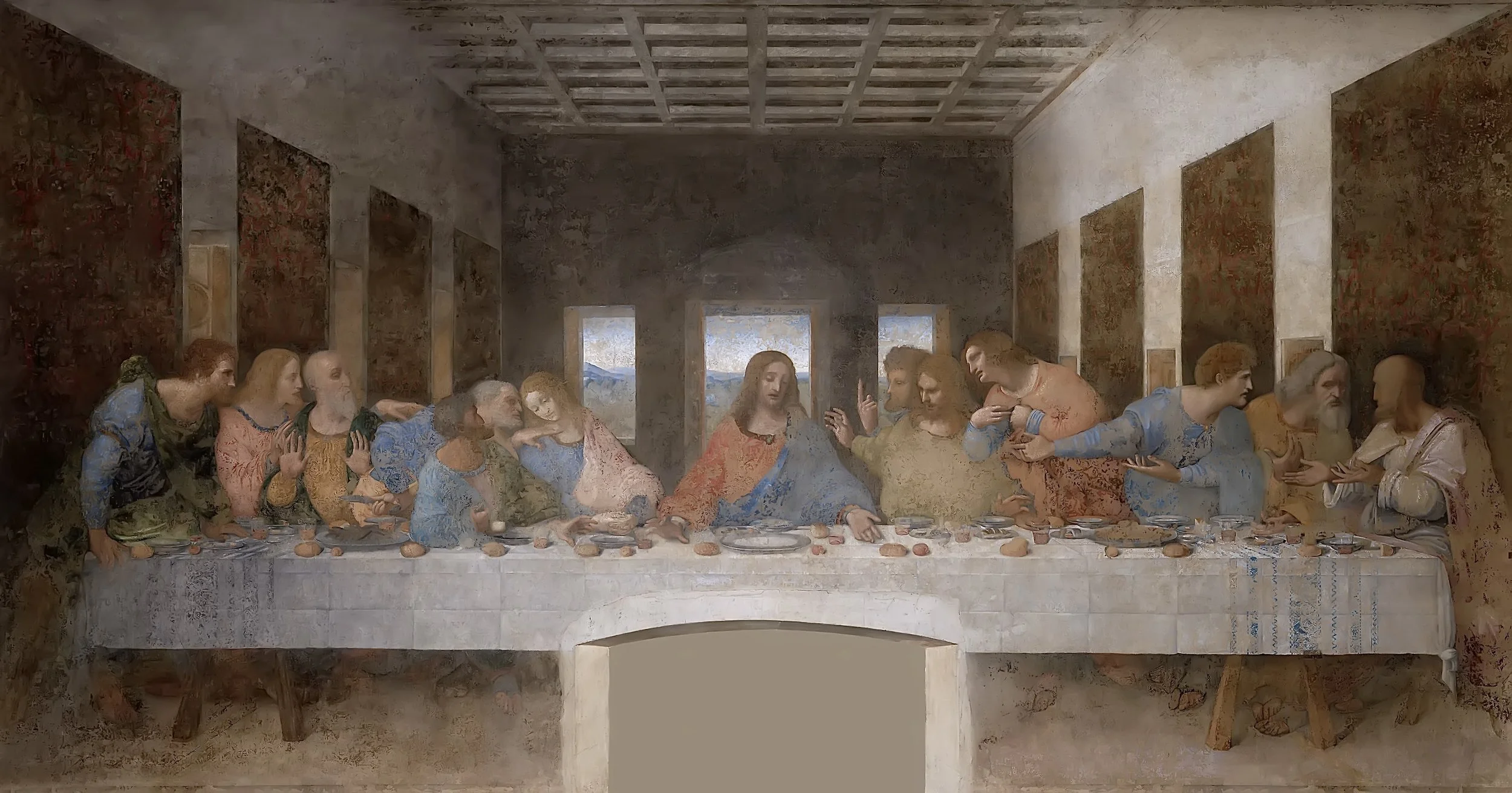
The Last Supper by Leonardo da Vinci created between 1495 and 1498
Jesus is the geometric center of the composition. A linear perspective uses the room's architectural lines to converge on Jesus’s right temple. The 12 apostles are divided into four clusters of three, which creates a visual pattern that offsets the discordant emotional reactions. Judas Iscariot is in shadow. The small purse he clutches contains silver coins. The overturned salt cellar nearby is ostensibly a symbol of betrayal. Peter leans in holding a knife, whereas John the Apostle is calm and inclined to the side. Three windows behind Christ presumably represent the Trinity, while the four groupings of apostles possibly reflect classical themes like the four virtues. The paint failed to bind properly to the stonewall in the humid refectory environment, resulting in rapid flaking of the mural soon after it was painted. It has survived through extensive modern restorations